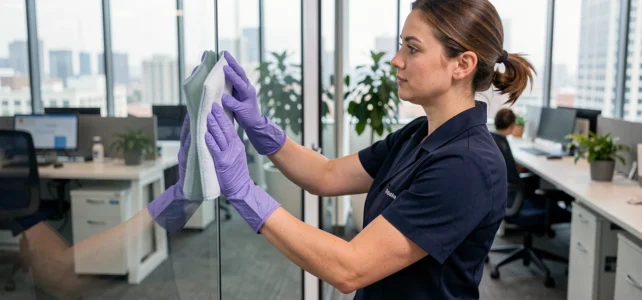
Office cleaning is no longer just about mopping the floors at the end of the day. Since the health crisis, the requirements for hygiene in professional premises have tightened, methods have become more technical, and the market for cleaning service providers has significantly expanded. Choosing a partner for cleaning your offices means going beyond the usual criteria (price, proximity) to examine less visible but crucial aspects: social compliance, traceability of interventions, and team stability.
Regulatory and Social Compliance of the Cleaning Service Provider
Before even comparing quotes, one point deserves priority verification: the administrative and social situation of the cleaning company. Field feedback shows that this filter alone eliminates a significant portion of vulnerable providers.
The URSSAF vigilance certificate confirms that the company is up to date with its social contributions. It protects the client from the risk of concealed work, a subject that can engage the joint liability of your own company. Professional liability insurance covers material or bodily damages that occur during interventions in your premises.
These documents are not mere formalities. They reflect the financial solidity of the provider and its ability to employ its agents under legal conditions. A provider that delays in providing these documents, or presents them as outdated, sends a clear signal about its mode of operation.
Companies specialized in office and professional premises cleaning publish their certifications and commitments directly on their website, which facilitates an initial sorting, as can be seen on https://www.horizonnet.be/ where this information is accessible.
Service Continuity and Absence Management in Office Cleaning

The quality of office cleaning is not only measured on the day of the commercial visit. It is tested on the morning when the usual agent is absent. Service continuity has become a central criterion in choosing a provider, and feedback from facility managers converges on this point.
A reliable partner has a clear replacement protocol. This implies a pool of agents trained in the specifics of your premises, not just a temporary worker sent without briefing. The presence of an identified site manager, reachable and capable of intervening in case of problems, distinguishes structured providers from mere intermediaries.
Ask the question directly during the consultation: how are unexpected absences managed, within what timeframe is a replacement mobilized, and does this replacement have access to your site’s specific instructions? The answers (or lack thereof) say a lot.
Traceability and Reporting: Proof of Service and Quality Control
The professional cleaning market is shifting towards more measurable contracts. Client companies no longer settle for an invisible service performed outside office hours. They want proof.
Several tools now exist:
- Timestamped check-ins (badges, QR codes, mobile apps) that attest to the actual presence of the agent and the duration of the intervention.
- Before/after photos, integrated into digital checklists, that document the condition of the premises and identify discrepancies.
- Periodic visual audits, conducted by a supervisor from the provider or jointly with the client, according to a set of criteria defined in the contract.
This type of reporting transforms the client-provider relationship. It is no longer about trusting blindly, but about having actionable data to adjust the service. A provider that refuses this level of transparency, or that does not have the tools to implement it, limits your ability to manage.
Field feedback varies on the degree of sophistication required. For small offices, a simple logbook may suffice. For multi-site premises or high-traffic areas, a digital tool quickly becomes essential.
Team Stability and Working Conditions of Cleaning Agents
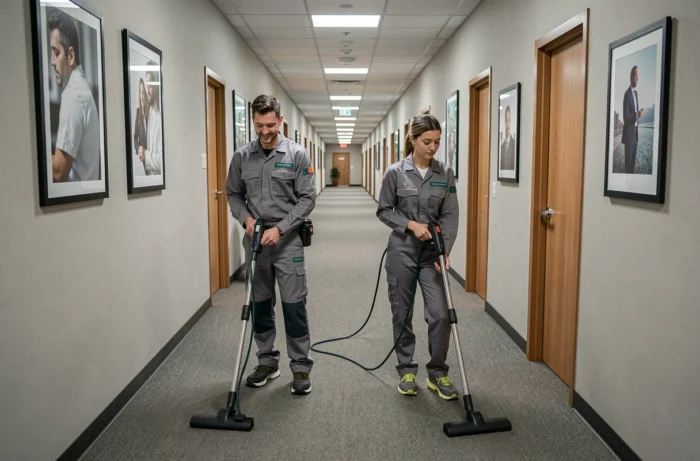
One aspect rarely addressed in provider comparisons: the working conditions of the agents who work in your premises. The link between team stability and cleaning quality is direct.
A high turnover means agents who do not know your premises, who have not integrated your instructions, and who take several weeks to reach the expected level. Conversely, an agent who has been present for several months knows the sensitive points of your offices, anticipates seasonal needs, and develops a trusting relationship with your teams.
Training plays a comparable role. A provider that invests in the skill development of its agents (cleaning techniques, use of specific products, sanitary protocols) delivers a more consistent service. Ask the provider about its training policy and the average seniority of its teams. These indicators are more revealing than a catalog of services.
Specifications and Cleaning Contract: What Must Be Clearly Stated
The cleaning contract is the document that protects both parties. Available data on disputes in this sector shows that most conflicts arise from a poorly defined scope, not from bad faith.
A precise specifications document should cover at least:
- The exhaustive list of areas to be maintained, with the associated frequency for each (daily, weekly, monthly).
- The contractual response times in case of complaints or requests for exceptional interventions.
- The terms for revising the contract: how to adjust services if your workforce changes, if you move premises, or if new spaces are developed.
- The conditions for termination, with reasonable notice and clear exit clauses.
A quote that limits itself to a line “office cleaning, X visits per week” without detailing the tasks is a warning sign. The granularity of the specifications reflects the seriousness of the provider.
The choice of a partner for the maintenance of your offices relies less on the hourly rate than on the provider’s ability to document its interventions, maintain its teams, and adhere to a precise contractual framework. A provider that is transparent about its social compliance, equipped to ensure traceability, and capable of guaranteeing service continuity offers a solid foundation for a lasting collaboration.