
The leisure market in France is restructuring around a criterion that generalist guides underestimate: the friction at startup. Preparation time, entry cost, required equipment, compatibility with short time slots – these parameters determine the sustainability of an activity far more than its initial appeal. We have observed a clear shift towards modular practices, achievable in sessions of twenty to forty minutes, without heavy material commitments over several seasons.
Friction at startup: the criterion that filters viable leisure ideas
An activity that requires an initial investment greater than a few dozen euros or several hours of learning before producing a tangible result will be abandoned in most cases. We recommend classifying any leisure idea according to three axes before committing to it.
- Actual entry cost: basic equipment, potential subscription, consumables. Watercolor or pencil drawing starts with a minimal kit, whereas pottery on a wheel requires access to a workshop.
- Time before first satisfaction: punch needle or scrapbooking produce a finished object in a single session, unlike clothing sewing which requires several patterning steps.
- Compatibility with available space: some creative activities fit on a corner of a table, while others require a dedicated workshop or garden. This filter alone eliminates half of the suggestions found in classic lists.
Platforms that list leisure ideas are beginning to segment their offerings according to these criteria, as can be seen on the Starlight Infos website where activities are categorized by usage context rather than vague themes.

Creative leisure for adults: regular routines rather than occasional activities
The positioning of creative leisure has changed. Watercolor, air-dry clay, punch needle, or embroidery are no longer presented as activities for rainy weekends. They are integrated into weekly routines aimed at relaxation and mental reset.
This shift has practical consequences. Equipment is chosen to last and remain accessible at all times, not to be stored between uses spaced weeks apart. A compact watercolor kit on a desk works better than an easel that needs to be set up and taken down.
Selecting a creative practice based on your profile
The relevant question is not “what activity is trendy” but “what format fits my actual free time.” A person with fragmented twenty-minute slots will get more out of pencil drawing or lettering than scrapbooking, which requires significant setup and cleanup time.
For absolute beginners, drawing and watercolor remain the most accessible entry points. No machine, no expensive consumables, no drying time incompatible with a shared apartment. Sewing or pottery come later, once the habit of regular practice is established.
Nature and outdoor activities: segmenting by logistical constraints
France is among the European countries offering the greatest diversity of outdoor and thrill-seeking experiences. Competing content readily lists hiking, cycling, kayaking, or tree climbing, but never helps the reader decide between these options.
We propose a more operational breakdown based on actual logistical constraints.
Activities without travel: the garden as a playground
A garden, even a modest one, opens up an underutilized catalog of activities. Square vegetable gardens, nature observation with identification guides, building huts with children, water games in summer. These practices require no travel and adapt to very short time slots.
Gardening as a family, in particular, combines moderate physical activity, concrete learning for children, and visible results within a few weeks. It is one of the few hobbies that remains relevant over several seasons without needing new equipment.
Activities requiring short travel
Amusement parks, water sports centers, and suburban forests make up the second circle. The determining criterion here is the ratio of travel time to activity time. A kayaking trip forty minutes away for one hour on the water does not yield the same return as a tree climbing course fifteen minutes from home for two hours of activity.
Localized booking platforms (“near you”) facilitate this calculation by displaying distance and duration, but few integrate the actual preparation time (equipment, safety briefing, waiting).
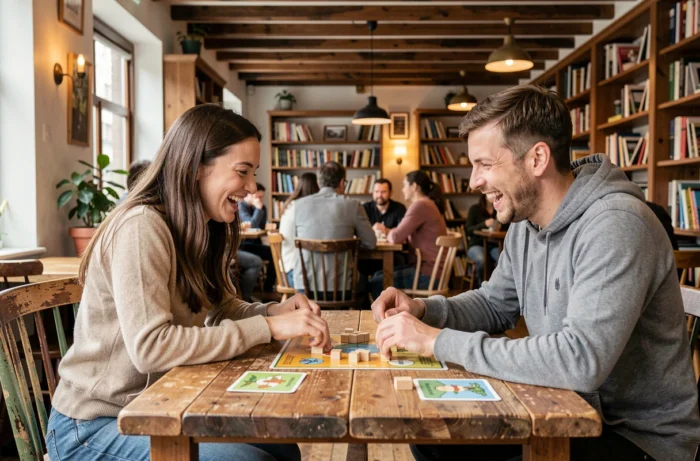
Family leisure and games at home: going beyond the list of ideas
Competing guides pile up suggestions (board games, cooking, DIY) without addressing the central issue: the variable attention span according to age makes most family activities asymmetrical. A pastry workshop captivates a four-year-old for twenty minutes and a ten-year-old for an hour. Planning two levels of involvement in the same activity radically changes the experience.
Cooking workshops and team games: structuring the session
For family moments at home, the key is to set a duration and a concrete goal before starting. A cooking workshop works better with a recipe chosen together, roles distributed by age, and a consumable result within the hour.
Cooperative board games deserve special attention. They eliminate the frustration of defeat for younger players while maintaining strategic interest for adults. This format remains one of the most effective for occupying an evening or a rainy holiday without resorting to screens.
Budget and free time: two variables that guides ignore
Most articles on leisure ideas treat the budget as a footnote. In practice, it is the first filter. A free activity practiced regularly generates more satisfaction than a paid experience attempted once a quarter.
Leisure activities with almost no cost that last over time share a characteristic: they produce measurable progress. Running (time, distance), drawing (filled sketchbook), reading (finished books). This feedback loop maintains motivation without requiring additional spending.
Available time remains the other structuring variable. It is better to have three activities compatible with thirty-minute slots than one theoretical passion that requires complete half-days. Calibrating leisure activities to one’s actual schedule, rather than an ideal vacation, avoids accumulating unused equipment and the guilt that comes with it.