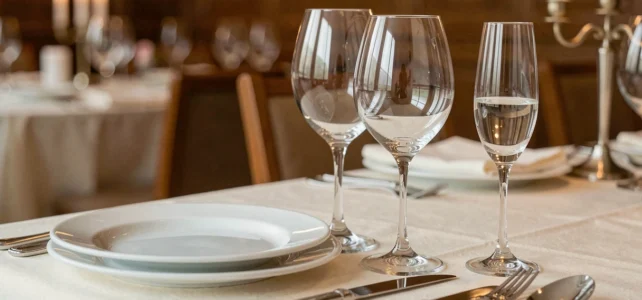
Setting a table for a refined dinner requires mastering the placement of glasses, but most guides start from an assumption that is rarely verified: a table large enough to align four or five glasses per guest without discomfort. In reality, French dining tables rarely exceed a comfortable width for this type of setup, and the question then becomes one of intelligent sorting between academic rules and the actual comfort of guests.
Glasses on a small table: adapting the setup to the actual space
The French tradition of table setting calls for an alignment of glasses at an angle or in a triangle, above the knife, from largest to smallest. This scheme works perfectly on a wide reception table. On a standard dining table, aligning four glasses per place setting creates what restaurant professionals call a “showcase effect”: the table appears overloaded even before the dishes arrive.
The most relevant logic today is to build the glassware based on the actual menu, not a fixed scheme. If the meal only includes a white and a red wine, there is no need to place a champagne flute from the start. The champagne, if served with dessert, can be brought at the time of service. This principle avoids cluttering the space and maintains the visual clarity of each place setting.
To delve deeper into the arrangement of glasses on the table according to French conventions, the basic reference remains the alignment above the knife, slightly shifted to the right. However, this reference is adjusted according to the available space.
Spacing of glasses: the criterion that guides overlook
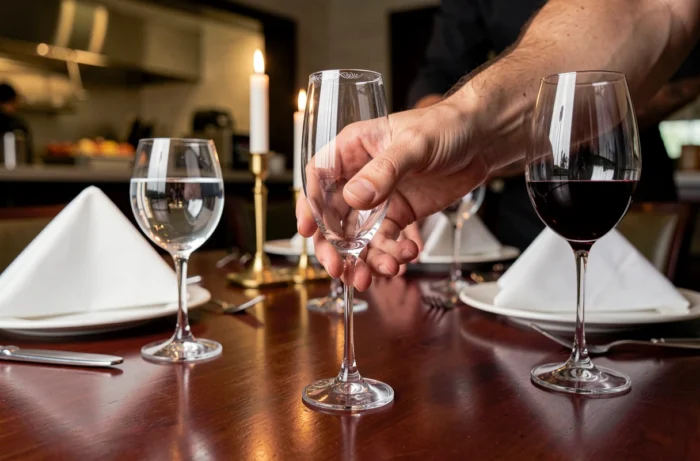
A detail rarely addressed in classic content concerns the spacing between the bases of the glasses. On a narrow table, the bases end up touching, which causes clinking during service and complicates handling. The bases of the glasses should never touch: a gap of about two fingers between each base is sufficient to ensure stability and comfort.
This spacing also has a visual role. A “wall of glass” aligned edge to edge gives an impression of density that is not compatible with the elegance sought during a dinner. The space between the glasses creates a rhythm, a breath in the composition of the table, just like the space between the cutlery and the plate.
Reducing the number without losing refinement
Placing two glasses per guest (water glass and main wine glass) constitutes a perfectly acceptable setup for an elegant dinner. Two well-chosen glasses are better than four mismatched glasses. The water glass, the largest, is placed on the left. The wine glass is positioned slightly back, to its right.
If a second wine is planned, the third glass is added by extending the diagonal line. Beyond three glasses on a table of standard dimensions, the risk of visual overload increases significantly.
Order of service and glass arrangement: starting from the meal, not from tradition
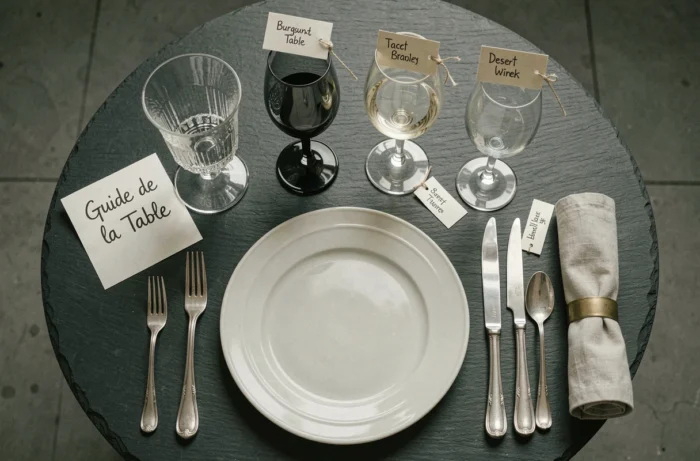
The traditional method places the glasses in a codified order: water glass, red wine glass, white wine glass, champagne flute. This sequence corresponds to a formal reception meal with several food-wine pairings. For a home dinner, even a refined one, the reality of the menu dictates the glassware.
Here are the principles that guide a coherent setup with the planned service:
- The water glass is always present and occupies the position closest to the plate, above the knife.
- The glass for the wine served first is placed just to the right of the water glass, slightly back towards the edge of the table.
- Any glass corresponding to a wine served later in the meal can be brought at the appropriate time, rather than placed from the start.
- The champagne flute, if needed, is positioned last in the diagonal line or arrives with dessert.
Adapting the glassware to the menu avoids overloading the table and gives the setup a functional logic that guests intuitively perceive.
French or English setting: what changes for the glasses
The French tradition places the cutlery with the convex side facing the tablecloth, and the glasses align in a descending diagonal from left to right. The English tradition reverses the placement of the cutlery (convex side facing up) but maintains a similar logic for the glasses.
However, the English style tolerates more variations in the arrangement of the glassware, notably a compact triangular placement rather than a line. This option works particularly well on small tables: the triangle groups three glasses in a more confined space than a diagonal line, while remaining readable.
Choosing glasses for a refined dinner: material and proportions
Crystal remains the material associated with the elegance of French table settings. Its transparency and fineness immediately distinguish a well-set table. Crystal glasses also produce a characteristic sound at the moment of the toast, a sensory detail that contributes to the atmosphere of the meal.
Stemless glasses, long confined to informal uses, now appear on some contemporary tables. Field feedback varies on this point: some consider them suitable for a modern and relaxed dinner, while others believe they lose elegance in exchange for stability. The context of the meal decides: a classic dinner calls for a stemmed glass, while a more freely inspired meal can do without it.
Harmonizing the glasses with each other
An elegant setup relies on the visual coherence of the glassware. Mixing glasses from different ranges creates a noticeable mismatch. If the complete service is lacking, it is better to reduce the number of glasses set and maintain a unity of style.
- Favor glasses from the same collection, even if simple, rather than assembling mismatched pieces.
- Check the relative height: the water glass should remain the tallest, the white wine glass the shortest.
- Coherence takes precedence over quantity: three matching glasses impress more than five disparate glasses.
The arrangement of glasses for a refined dinner is not just about applying a scheme. It is a balancing act between the tradition of French service, the actual dimensions of the table, and the planned menu. Placing only the necessary glasses, paying attention to the spacing between each base, and choosing coherent glassware: these three decisions are enough to transform a correct setup into a truly elegant table.