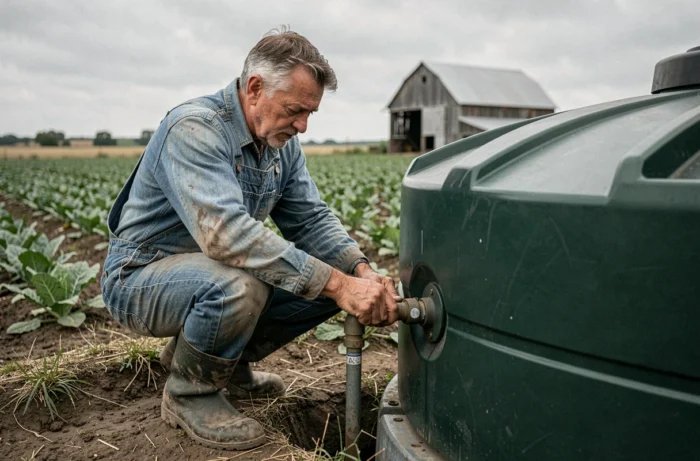
Funding mechanisms for rainwater harvesting tanks in agricultural operations are divided among water agency programs, regional and departmental aid, and measures from the Common Agricultural Policy. Their coordination depends on the hydrographic basin, the type of production, and the targeted storage volume. Here, we detail the least documented mechanisms and the points of caution to consider before preparing a file.
Emergency Agricultural Law 2025-2026 and Retention Declaration Regime
The emergency agricultural law, enacted in August 2026, aims to double agricultural water storage volumes by 2035. It simplifies technical rules for hillside retention systems of less than three hectares and strengthens the integration of storage projects into the Sdage and Sage.
The critical point concerns rainwater and runoff retention systems of less than 75,000 m³. A simplified regime by simple declaration (instead of a prefectural authorization) was voted in 2025, but the implementing decree remains unpublished as of summer 2026. In practice, operators wishing to invest quickly in rainwater storage find themselves in a regulatory gray area: the legal framework exists in the law, but not yet in the implementing texts.
This uncertainty directly impacts the profitability calculation of a tank. Without a decree, the administrative procedure remains that of the classic authorization, which is longer and more costly in preliminary studies. We recommend checking with your departmental DDT if the decree has been published before launching a funding file, as the amount of instruction fees differs significantly between the two regimes.
For a complete overview of the available mechanisms, we refer to agricultural aid on Finance Factory that detail eligibility conditions by project type.
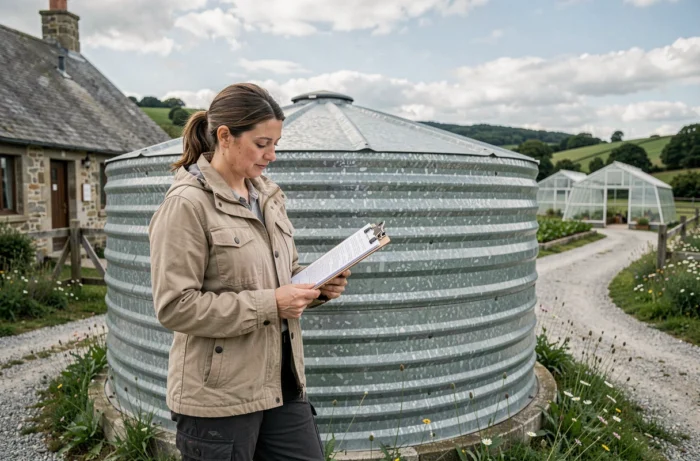
Water Agency Aid: Variable Budgets by Basin
The six metropolitan water agencies fund agricultural rainwater harvesting, but with criteria and rates that vary significantly from one basin to another. The grant rate depends on the hydrographic basin, not the department.
Seine-Normandy Water Agency
This agency targets projects that substitute for drinking water in livestock farming. Eligible investments cover the tank, the filtration system, and the connection to farm buildings. Files are processed within the framework of annual calls for projects, which imposes a strict submission schedule.
Rhône-Mediterranean-Corsica Water Agency
The intervention program finances equipment that reduces withdrawals from surface or groundwater. Farms in water distribution zones (ZRE) benefit from increased rates. Eligibility requires demonstrating a quantifiable reduction in withdrawal from the existing resource.
Loire-Brittany Water Agency
Loire-Brittany incorporates rainwater harvesting projects into its “climate change adaptation” section. Eligibility criteria prioritize livestock farms facing recurring summer supply tensions.
In all cases, the processing of the file requires a prior diagnosis of the farm’s water needs. This diagnosis, often carried out by the departmental agricultural chamber, conditions access to funding. Failing to conduct it before ordering the tank is the most common mistake: water agencies never retroactively fund equipment that has already been installed.
Regional and Departmental Aid for Agricultural Tanks
Several regional and departmental councils offer complementary mechanisms to water agencies. The coordination between these aids and basin subsidies is the technical point to master: cumulative funding is possible, but capped.
- The Auvergne-Rhône-Alpes Region finances the optimization of water use in livestock farming, including rainwater storage tanks in livestock buildings. The mechanism covers preliminary studies and material investments.
The classic trap is to request regional aid without checking compatibility with the water agency’s program. Cumulative rules vary: some regions deduct the agency’s subsidy from the eligible amount, while others apply a global cap on public aid. Checking the maximum cumulative public aid rate before submitting the first file avoids having to reimburse an overpayment.
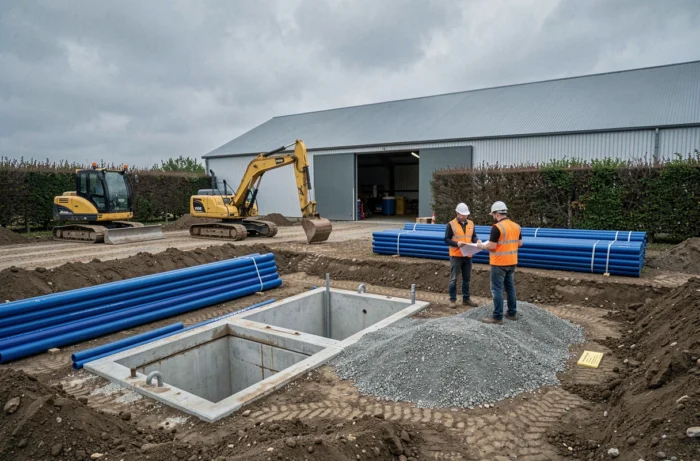
National Strategic Plan CAP and PCAE Measures
The National Strategic Plan (PSN) of the CAP includes support measures for water management in agricultural operations through the Competitiveness and Adaptation Plan for Agricultural Operations (PCAE). Investments in rainwater harvesting may be eligible, subject to validation by the Region managing the FEADER envelopes.
The PCAE operates through regional calls for projects with selection criteria specific to each rural development program. Rainwater tanks rarely appear as isolated priority investments: they are generally funded as part of a broader project for building livestock or farm modernization.
The most effective strategy is to integrate the tank into a larger investment project (construction or renovation of a building, compliance upgrades). The PCAE file gains in eligibility when rainwater harvesting is part of a coherent whole rather than an isolated request.
The submission calendar for PCAE files, specific to each Region, does not always coincide with that of the water agencies. Preparing both files in parallel requires several months of anticipation. The departmental agricultural chambers assist with this dual processing, and this is one of the few cases where their intervention fully justifies the diagnostic costs.
With the emergency agricultural law redefining storage priorities, upcoming PCAE calls for projects should place greater emphasis on rainwater harvesting equipment. The implementing decree on simplified retention, when published, could also unlock envelopes currently frozen in certain regions.