
The Citroën DS attracts buyers who are not just looking for an old car, but a unique mechanical object. Finding the right used model requires knowing where to look, and especially what to look for. Between hidden corrosion, the vehicle’s administrative status, and notable differences from one engine to another, each DS on the market tells a different story.
Collection registration on a Citroën DS: a choice that changes everything
Have you spotted a DS you like in the listings? Before even checking the mechanics, ask the seller a simple question: what does the registration document say? The answer determines your obligations, your rights to drive, and even the frequency of technical inspections.
A DS registered with a normal registration document is still subject to technical inspection every two years, regardless of its age. Simply being over thirty years old does not trigger any automatic benefits. To benefit from the collection status, you must obtain a FFVE certificate and ensure that the vehicle is in its original condition.
Once the mention “collection vehicle” is noted, the rules change. DS models registered from 1960 onwards undergo technical inspection every five years. Those registered before 1960 are exempt. This detail is important, as the DS has been produced since 1955. Depending on the exact date of first registration (not the model year), the applicable regime varies. You can read more on Actu en vrac for useful additional information on this topic.
The collection registration also offers an exemption from circulation restrictions in low-emission zones. For occasional urban use, this is a concrete advantage. In return, any major modification jeopardizes the collection status: an engine replaced with a newer block, a paint job in a non-original color, or anachronistic wheels can pose problems during the renewal of the certificate.
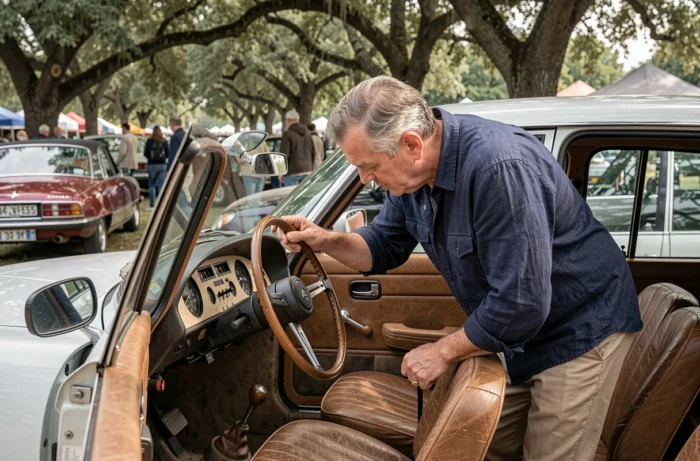
Structural corrosion on a used DS: areas to inspect
The body of a DS is deceptive. The outer panels made of aluminum (hood, front wings, roof) do not rust. The problem lies beneath, in the steel structure.
The layered design of overlapping sheets retains moisture alarmingly. The critical areas start at the front floors and worsen towards the rear. Here are the points to check first:
- The front and rear chassis rails, including their closing plates, often hidden by thick sealant or anti-stone chip coating
- The location of the fuel tank, accessible only after removing the rear bench seat, the closing plate, and the tank itself (severe corrosion can hide behind an in-place tank)
- The rear crossmember, which contains the anchors for the rear chassis rails: the inside can be heavily corroded without visible perforation from the outside, and only an endoscope or a cut allows for verification
- The tops of the rear wheel arches, the trunk floor, and the closing plate that supports the taillight bracket
- The roof edge, an area often overlooked during quick inspections
A seller who refuses to remove the bench seat or show the underside on a lift should raise a red flag. On a DS, invisible rust costs more than visible rust.
Why a low price for a DS sometimes hides a heavy restoration
A DS listed at a price significantly lower than the market often has advanced structural corrosion. Restoring the chassis rails and rear crossmember requires specialized bodywork, which is lengthy and costly. A well-inspected example at market price is a better safeguard than a supposed good deal.
Engine and version: choosing your Citroën DS based on intended use
The DS range spans twenty years of production and several engine options. The choice is not limited to aesthetic preference.
The early DS models (and the ID, their simplified variant) come with modest engines. Driving pleasure improves significantly with the larger displacement engines that appeared in the second half of the 1960s. Injection versions offer better torque and smoother driving than carbureted versions, which is important for regular use.
Are you considering driving it daily or almost? Opt for an engine powerful enough to handle hills or highways without struggle. The entry-level versions are more suited for leisurely Sunday drives or static collections.
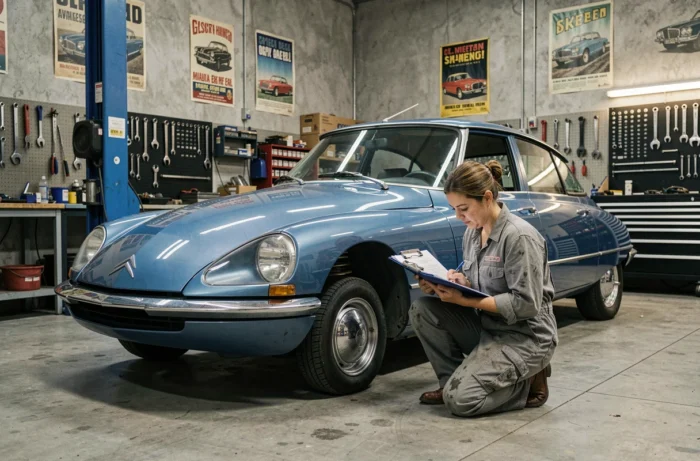
The issue of hydraulics
The hydropneumatic suspension is what makes the DS charming, but it is also its main maintenance concern. Check the condition of the spheres, the color of the hydraulic fluid (the green LHM), and the absence of leaks in the pipes. A DS that takes more than a few seconds to rise at startup indicates a tired system.
A well-maintained hydraulic system ensures the exceptional road handling that distinguishes the DS from all its contemporaries. A neglected system turns every journey into a source of worry.
Check the authenticity and mileage of a DS before purchase
The odometer of a used DS is not a reliable proof by itself. On vehicles of this age, odometers have often been replaced or reset during restorations. Focus your attention on the actual condition of wear parts: seats, pedals, steering wheel, carpets, door seals.
The overall authenticity of the vehicle also deserves careful examination. An engine replaced with a block from another year, a modified dashboard, or body elements not conforming to the original technical sheet can reduce resale value and, as mentioned earlier, compromise the collection status.
Always request documented history: restoration invoices, old registration documents, construction photos. A passionate owner generally keeps a thick file. The complete absence of documentation on a DS presented as restored should raise caution.
Acquiring a used Citroën DS remains a process where patience pays off more than haste. A structurally sound example, with clarified administrative status and traceable history, is always worth more than a model that looks appealing in photos but is opaque upon examination.