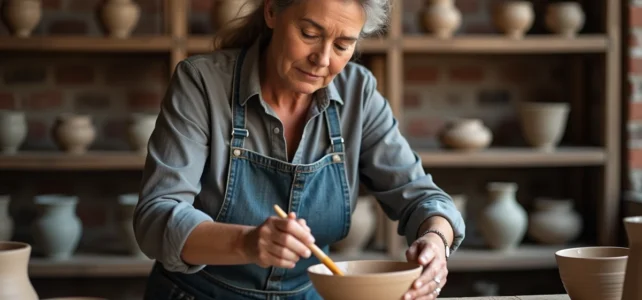
Ceramic glazing and raku firing share a common vocabulary (glaze, kiln, clay, firing), but their technical constraints diverge on specific points: melting temperature, glaze composition, and the behavior of the body under thermal shock. Comparing these two approaches allows us to measure where the real risks lie and the margins for maneuver for the ceramist.
Classic glazing vs. raku: compared technical parameters
Putting the two processes side by side reveals differences that condition the choice of materials, the preparation of pieces, and the precautions for firing.
| Parameter | Classic glazing (stoneware, earthenware) | Raku firing |
|---|---|---|
| Glaze firing temperature | Variable depending on the type of glaze (low, medium, or high temperature) | About 1,000 °C, low temperature |
| Cooling | Slow, controlled in the kiln | Brutal thermal shock (air, water, sawdust) |
| Type of clay | Wide choice (earthenware, stoneware, porcelain) | Chamotte clay to withstand thermal shock |
| Sealing of the piece | Generally sealed after firing | Pore-rich piece, not sealed |
| Food use | Possible with compliant glazes | Not recommended (porosity, cracks, glaze composition) |
| Surface effects | Homogeneous and reproducible | Cracks, smoking, metallic reflections, uniqueness |
The most structuring difference concerns cooling. In classic glazing, the temperature drop takes several hours. In raku, the piece goes from about 1,000 °C to room temperature in a few minutes. This thermal shock requires chamotte clay, capable of absorbing expansion without cracking.
Details regarding specific techniques and precautions to take during raku glazing are documented on the Les Embellies Déco website for further exploration of each step of the process.
Glazes for raku: composition and redox reaction
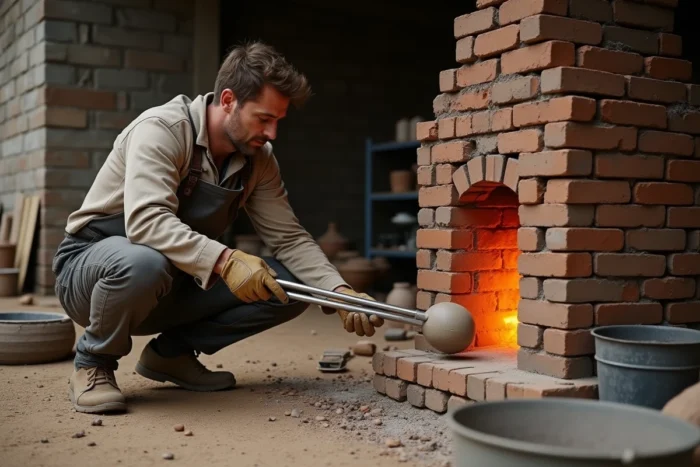
In standard ceramic glazing, the glaze melts, spreads, and cools slowly. Its surface remains homogeneous from one firing to the next if the parameters are stable. In raku, the glaze does not have time to stabilize. The reduction phase (contact with burning sawdust, deprivation of oxygen) alters the metallic oxides present in the glaze.
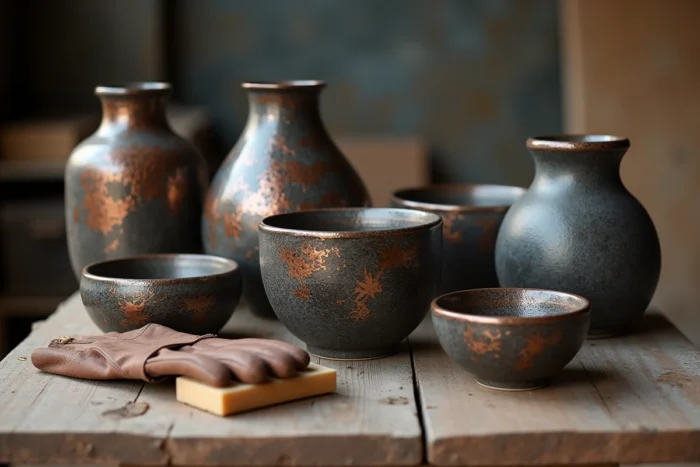
It is this redox reaction that produces the characteristic metallic reflections of raku. A glaze containing copper can shift from green to copper red depending on the duration and intensity of the reduction. The result is unpredictable, making each piece a unique specimen.
Selection of glazes and formulation constraints
Raku glazes are formulated to melt at low temperatures. They often contain powerful fluxes (frit, borax) that lower the melting point. This composition makes them unsuitable for food use in most cases: the residual porosity of the body and the cracks in the glaze prevent any guarantee of sealing or non-migration of heavy metals.
The issue of glaze toxicity is becoming increasingly important in discussions among ceramists. Recent workshop feedback highlights the need to control the composition of glazes, particularly to identify and limit the use of potentially harmful components (lead, barium, certain metallic oxides). This concern goes beyond basic safety guidelines: it touches on regulations regarding food contact and a growing demand for transparency in formulations.
Safety precautions in raku workshops: underestimated risks
Raku firing involves handling at high temperatures, outdoors or in a well-ventilated space. The most obvious risks (burns, fumes) are generally known. Others are less so.
- When scraping glaze drips or cleaning kiln shelves, dry glaze can project sharp shards towards the face and hands. Ceramists consistently recommend wearing protective goggles and gloves for these operations, just as for sanding raw materials.
- Smoking in sawdust generates carbon monoxide. Working outdoors or under a widely open awning remains the only reliable precaution, as a simple dust mask does not filter this gas.
- Thermal shock can cause a piece to crack if the clay is not sufficiently chamotte or if air bubbles were trapped during shaping. Wearing eye protection when removing pieces from the kiln minimizes the risk of injury from projection.
These precautions add to the usual rules of ceramic glazing (ventilation during the preparation of powdered glazes, hand washing, regular cleaning of work surfaces).
Smoking and post-firing raku: what determines the final result
Once the piece is removed from the kiln, the ceramist has a few seconds to decide on the post-firing treatment. Three main options exist: smoking in sawdust, immersion in water, or cooling in open air. Each choice produces a different result.
Smoking in sawdust or wood chips is the most common method. The organic material ignites upon contact with the glowing piece, and then combustion in a confined space (under a metal lid, for example) deprives the glaze of oxygen. The unglazed areas absorb carbon and darken, while the cracked glaze allows smoke to penetrate the fissures, creating the typical network of dark lines of raku.
Immersion in water, on the other hand, abruptly freezes the glaze and stops the reduction. The result is shinier, with less pronounced cracks.
Smoking materials and variability of effects
The type of sawdust (softwood, hardwood, fine or coarse grain) alters the intensity of the smoking. Fine sawdust burns quickly and produces a short reduction. Coarse chips prolong combustion and intensify the darkening of the raw areas. There is no universal formula: each combination of clay-glaze-fuel-duration yields a unique result.
Raku remains a technique where the element of unpredictability is part of the result. Mastering raku glazing and firing means accepting to work with variables that are only partially controllable, relying on rigorous preparation of the pieces, informed choices of glazes, and safety conditions adapted to each stage.