
The market for plots with mobile homes by the sea is entering a phase where regulations weigh as heavily as location on the final yield. Between the national online service for declaring tourist accommodations, the new powers of municipalities in tight zones, and the tightening of occupancy rules along the coast, the parameters to consider before investing in 2026 have significantly evolved.
Coastal regulatory constraints in 2026: what changes for plots with mobile homes
The legal framework applicable to mobile homes installed by the sea has tightened on several simultaneous fronts. The most significant point concerns the national online declaration service that became mandatory in spring 2026. Any mobile home offered for seasonal rental, whether through a platform or directly, must now have a registration number displayed on each listing.
This obligation is no longer limited to large cities or tight zones: it covers the entire French territory. For an investor targeting a plot in a coastal campsite, this means an additional administrative layer, but also increased traceability of rental income.
Coastal municipalities also have enhanced levers. Some can impose by deliberation a change of use for tourist accommodations, and sometimes require a minimum level of energy performance.
A mobile home operated for seasonal rental in a municipality in a tight zone may be denied authorization if these criteria are not met. Searching for a plot of land with a mobile home for sale by the sea now requires checking the municipal regulations even before considering the price.
Locally, several Breton and Mediterranean municipalities have enacted stricter regulations in 2026 against bivouacking and wild camping. These measures do not directly target plots in declared campsites, but they reflect increasing pressure on the tourist occupation of the coastline.
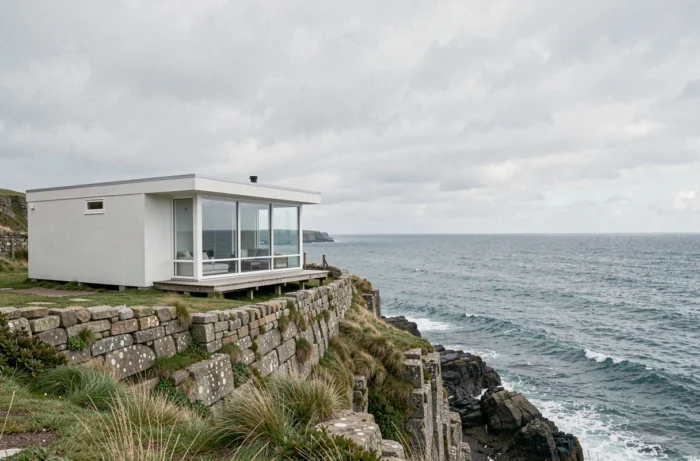
Comparison of mobile home investment: personal use vs seasonal rental
The central question for a buyer remains whether the plot will serve as a family getaway or a source of rental income. The fiscal and regulatory implications differ significantly depending on the chosen scenario.
| Criteria | Personal Use | Seasonal Rental |
|---|---|---|
| Registration number (online service) | Not required | Mandatory since spring 2026 |
| Change of use in tight zone | Not applicable | May be required by municipal deliberation |
| LMNP status | Not applicable | Applicable, with micro-BIC or real regime |
| Property tax | None (movable property) | None (movable property) |
| Depreciation at resale | Significant from the first year | Identical, partially offset by generated income |
| Camping constraints | Internal regulations, plot contract | Regulations + compliance with tourist rental |
The mobile home remains a movable property: no property tax or notary fees, which eases entry into the investment. However, the rapid depreciation of the property after purchase is the main barrier to building wealth. This factor weighs more heavily for strictly personal use, where no income offsets the loss of value.
The impact of LMNP status on net profitability
The non-professional furnished rental regime allows for the accounting depreciation of the mobile home and the deduction of expenses (plot rent, maintenance, insurance). Under the real regime, depreciation can neutralize taxation on rental income for several years. This mechanism remains the main tax lever for mobile home investors, provided that the rental generates a sufficient volume of rented weeks.
Plot rent and fixed costs in coastal camping: key areas to monitor
The rental contract for the plot is the key document for any mobile home investment. Its duration, renewal conditions, and the amount of annual rent determine the financial viability of the project in the medium term.
- The annual plot rent varies significantly depending on location, the classification of the campsite (stars), and the immediate proximity to the beach. Four or five-star campsites on the front line charge significantly higher rates than those further back.
- Additional costs include the setup (water, electricity, drainage connections), maintenance of the plot, and sometimes a contribution to common facilities (pool, activities).
- The exit clause deserves careful reading: some contracts require the campsite to buy back the mobile home at a depreciated price, while others require its removal at the owner’s expense at the end of the contract.
A high plot rent combined with an unfavorable exit clause can negate profitability, even with a correct occupancy rate in high season. The ratio between the plot rent and the expected weekly rental income is the indicator to calculate as a priority.
Choosing a coastal location: technical criteria beyond the sea view
Proximity to the beach remains the primary valuation criterion, but other technical parameters directly influence the yield and sustainability of the investment.
The local urban planning plan (PLU) of the municipality determines whether the campsite can maintain or expand its pitches. Some coastal municipalities have tightened their occupancy rules in 2026, which may affect the renewal of the campsite’s operating permits. Checking the campsite’s compliance with the current PLU protects against the risk of closure or capacity reduction.
The remaining duration of the campsite’s operating contract also matters. A campsite whose permit expires in three years exposes the buyer of a mobile home to significant uncertainty regarding the continuity of their pitch.

The orientation of the plot, the quality of the soil (drainage, stability), and the distance to the campsite facilities (sanitary, road access) are less visible factors but weigh on usability comfort and rental attractiveness.
In 2026, the profitability gap between a well-chosen location, with a balanced plot contract, and a location taken by default has widened. Before comparing mobile home prices, it is the plot contract and the local regulatory framework that set the real ceiling of yield.